
Will Accelerators Boost a Startup’s Chance of Success?
- Mar 25, 2016
- 6 min read

They're dubbed "schools for startups": the startup accelerators that offer advice, investor connections and mentorship to a number of chosen teams for a small portion of equity in return. They are now all the rage. Thanks to the success of Y Combinator, Seedcamp and Techstars, the world's accelerator models are spreading like wildfire.
Despite the trend, many early-stage entrepreneurs remained misinformed about the truth behind the accelerators. Now let’s get things straight about such programs.
If you think all startup Accelerators are the same
Till now, I’ve heard countless budding entrepreneurs cry with joy and say: "I've been accepted to Y Combinator!", "I've got into TechStars" or "I'm in Kicklabs!" All while they jump up and down in excitement as if they have just won the 88th Academy Award.
I only have a few words for them: Good luck, but be humble.
If you actually think your startup will live or die based on whether you get accepted by an Accelerator, you probably don’t know enough about Accelerators. Mark Cuban said in a 2014 Triangle Business Journal interview, “Too many entrepreneurs think if they get into an incubator they have accomplished something. They haven’t. It’s a false sense of confidence. Call it incubator inflation.” According to WSJ, 45% of startup Accelerators have yet to produce a single entrepreneur who successfully raised venture funding after the process.
Today, there are around 235 seed Accelerators & groups worldwide and are still increasing. This means the variance in quality between Accelerators is probably going to widen as well. Yes - some Accelerators are incredibly competitive to get into, however their competitiveness is not a sure-reflection on that organizations ability to progress your company - let alone 'guarantee' it's success. While they can make some things easier, they don’t grease the wheels as much as you expect.
If you think you’ll get the smartest people in the room
Accelerating makes sense if you need to get from X to Y as fast as possible, but it makes little sense when you are lost in a fog of possibilities and you have no clear sense of direction or destination. Apparently, some crash courses provide such a wide network of mentors that founders spend a lot of time simply figuring out who they can and should listen to and engage with further, and that the wide variety of opinions are considered a “distraction”. That’s why we often hear startup founders described mentorship sessions as “overwhelming” and “contradictory”.
In other cases, the mentors simply didn’t have the domain-specific expertise or experience with certain markets or business models. Francisco Dao throws it out there with his article, “The dirty secret behind the incubator boom.”
“It is fairly standard practice for incubators to advertise huge rosters of mentors, but I can’t help but wonder how available or effective they are. In many cases, they seem like little more than the photos of fit personal trainers on the wall at the gym. The trainers look great, while the people working out are still flabby and out of shape because they don’t actually get much guidance.”
Indeed, it’s important for inexperienced entrepreneurs to learn the ins and outs of the game. A great idea will fall by the wayside without being properly executed. The U.S. Small Business Administration reports that some 70% of small businesses receiving mentoring services survive more than five years—roughly double the rate of non-mentored entrepreneurs. So there's little doubt that good mentorship can make an enormous difference. But when there's a disconnect between what a mentor can offer and what the startup expects, momentum can quickly stall.
Here’s a tip for wantrepreneurs: If you are going to give up a chunk of equity for a small amount of capital, you want access to good people who have done what you are setting out to do and can help you reach your goals. Ask who will actually be spending time with you and what their commitment levels are. Specialized Accelerators should have mentors fitting that profile. Going to a hardware Accelerator should mean you get to work with top-notch mentors from the hardware field and you should have access to prototyping tools and know-how. Don't join if you're not sure that you're getting value out of the deal.
If you think you'll get funded at D-day
For the fortunate, who aren’t aware of the process, this is how it goes. Applications open, startups submit their applications, interview processes later, teams are picked, brought onboard and after a three-month crash course, you are building off that first version of the product and then comes Demo day when you launch your product, introduce your startup, and get funded so that you can move forward. Except that there is one glitch. The funding never happens.
If you believe that many high-profile investors will swoon down from the heavens begging to send you company a check after completing your respective course of ass-kicking, you might be said to be “too young, too simple, sometimes naive" (words originally used by former-president Jiang Zemin in 2000 to lash out at a reporter from Hong Kong, and which have circulated widely among young people in Chinese popular society). While it’s hard to be accepted by an Accelerator, getting into one won’t necessarily guarantee the fact that your startup is going to get funded. In fact, statistics show that very few get funded. Here’s the data from TechStars, which shows the complete list of all of the companies that they’ve ever funded and their current status:
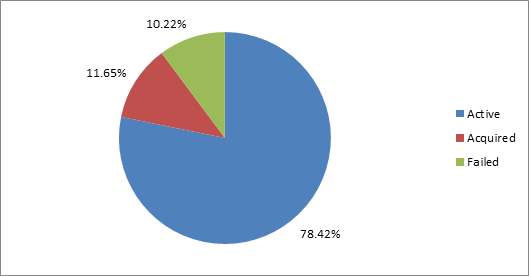
So, it is absolutely imperative that every founder dispel this myth immediately. It is better to view Accelerators as 'filters' - not enablers - for funding.
If you think you’ll get follow-on funding
You would think the Accelerators will help you secure the next round of funding. Bang wrong! Well, we all hear stories about those amazing demo days: excited media trying to identify the next big thing of the batch, investors queuing to talk with the leaders of the Apple/Microsoft/Facebook of tomorrow. The fact is that only absolutely top Accelerators (mainly in the US and we've seen some pretty good ones in Hong Kong) can organize such events. Fewer and fewer demo days end up with funding.
Most of demo days outside of big tech hubs don’t end up with immediate investment offers and the interest and attention of investors are not easy to maintain – there are just so many sources of deal flow these days. So, the next day most of founders go back to basics: coding, designing, hustling and growth hacking (or so they think).
If you think they will take care of your manufacturing
Every day you hear there’s a renaissance in hardware. So you think hardware is a cakewalk. Well, no! There’s a renaissance in prototyping. The real challenge comes in manufacturing at scale.
Many hardware startups could not turn their promising prototypes into actual businesses because they have a hard time understanding the different layers of the supply chain and identify the right mix of price, quality and relationship among the different manufacturers. That’s where they expect IoT Accelerators typically come in and help mitigate those risks, since they claim to be extremely hands on with deep industry experience across the whole value chain, from design, engineering, manufacturing and marketing. But reality is not what you think it is. To wit, there’s an ever-growing number of Accelerators popping up across Asia and most hail from the US. While some may not be familiar with Chinese suppliers and distributions networks, the others may not have strong links with China’s electronics Mecca, Shenzhen. If you think they understand the psyche of doing business in China and can deal with Chinese suppliers and manufacturers better than you do, think again.
Now you know a successful crowdfunding campaign is just the beginning of building a lasting business. The key is getting to know the supply-chain element of the business. Factories are likely to charge startups more for their early production runs, due to lower volumes and higher risk. So, it’s critical that you pick a good Accelerator, who has existing relationships with these local manufacturers, as they are more prepared to work with them.
If you think they will guide you through distribution
So you have a great prototype, amazing mentors, and you are getting millions in funding and but you stumble at the final stage—getting your products into brick and mortar. Much to your dismay, you found that your Accelerator hang you out to dry after you graduate. They didn’t tell you much about costing out the products, picking the right distributors, fixing the right price and so on.
In Hong Kong, Startup Launchpad is working on to bridge this gap, offering hardware startups support to launch, market, and distribute their products, all wrapped with a neat bow of marketing support. This 8-day electronics exhibition and conference brings together more than 70,000+ retailers, suppliers, investors, educators and startups around the world. Good news for hardware startups!
At the end of the day, bad Accelerators should be called out, but the best ones should be celebrated. After all, what’s important is for you to be clear about what you’re looking to achieve with any Accelerator, instead of blindly joining it since many successful ones joined Accelerator programs before. It’s always good to talk to some alumni, to know more about the values and the culture of the program, and see if it fits your startup’s personality and needs.
![[Infographic] 30 Social Media Tips for Trade Show](https://static.wixstatic.com/media/a19c3c_cb7cb642477e431c97b983146a5bea80~mv2.jpg/v1/fill/w_172,h_1000,fp_0.50_0.50,q_30,blur_30,enc_avif,quality_auto/a19c3c_cb7cb642477e431c97b983146a5bea80~mv2.jpg)
![[Infographic] 30 Social Media Tips for Trade Show](https://static.wixstatic.com/media/a19c3c_cb7cb642477e431c97b983146a5bea80~mv2.jpg/v1/fill/w_296,h_1724,fp_0.50_0.50,q_90,enc_avif,quality_auto/a19c3c_cb7cb642477e431c97b983146a5bea80~mv2.jpg)


Comments